Key Stage 2
Key Stage 2 (Years 3–6)
Key Stage 2 is a transformative stage in a child's educational journey, where learners build on the strong foundations established in Key Stage 1 and grow into confident, independent, and responsible individuals. Covering Years 3 to 6, our curriculum follows the National Curriculum for England, providing a broad, balanced, and ambitious educational experience that is both inclusive and highly personalised to meet the diverse needs, strengths, and aspirations of every learner.
We recognise that every child learns differently. Through adaptive teaching, evidence-informed practice, and a curriculum that offers both support and challenge, we ensure that all students are empowered to achieve their personal best. Drawing on a wide range of assessment data, including formative and summative assessments, internationally recognised GL Assessments, and national and international benchmark assessments, our teachers personalise learning to ensure that every student is appropriately supported, challenged, and inspired to succeed.
During these years, students deepen their subject knowledge, strengthen critical thinking skills, and become increasingly reflective and self-directed learners. They are encouraged to take ownership of their learning, embrace challenge, question, investigate, analyse, and innovate while developing the confidence and resilience needed to thrive in an ever-changing world.
Our holistic approach combines academic excellence with opportunities for creativity, leadership, collaboration, wellbeing, and character development, ensuring that every child is nurtured as a successful learner, a responsible global citizen, and a lifelong learner, fully prepared for the academic and personal challenges of Key Stage 3 and beyond.
Our Approach to Learning
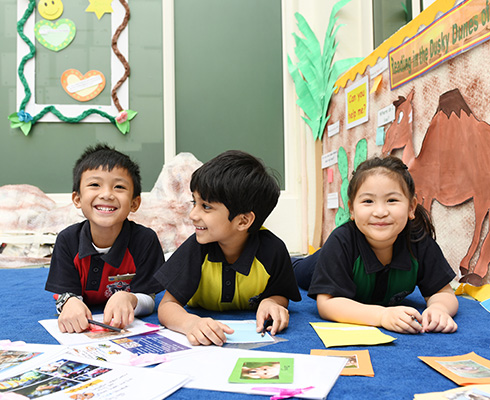
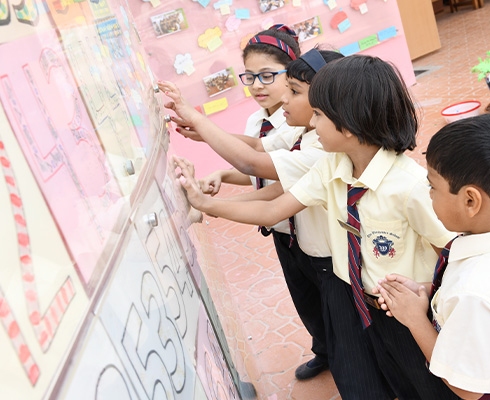
At Key Stage 2, learning becomes increasingly collaborative, inquiry-driven, and application-focused. We encourage students to think independently, solve complex problems, and make meaningful connections across subjects and real-world contexts.
Our teaching approach integrates:
- Inquiry-based and experiential learning
- Collaborative and project-based learning
- Cross-curricular learning opportunities
- Reflective and independent learning
- Personalised support and challenge
- Continuous assessment to inform progress
Students are empowered to become active participants in their own learning, developing resilience, curiosity, and the confidence to explore new ideas.
Developing Future-Ready Learners
Our Key Stage 2 curriculum equips students with the knowledge, skills, and values they need to succeed in an increasingly interconnected and rapidly evolving world.
Throughout the curriculum, students develop:
- Critical and analytical thinking
- Creativity and innovation
- Effective communication and collaboration
- Leadership and teamwork
- Problem-solving and decision-making
- Research and enquiry
- Independent learning
- Responsibility and ownership for their own learning
- Digital literacy and responsible technology use
- Adaptability, resilience, and perseverance
- Global awareness and intercultural understanding
These essential competencies prepare students not only for future academic success but also for life beyond the classroom.
The Key Stage 2 Curriculum
Our broad and balanced curriculum reflects the expectations of the National Curriculum for England, while incorporating local UAE requirements and providing opportunities for enrichment and personal development.
Core Subjects
- English
- Mathematics
- Science
Foundation Subjects
- Computing or Information and Communication Technology (ICT)
- Humanities (History and Geography)
- Music
- Physical Education (PE)
- French
Ministry of Education and other Subjects
- Arabic
- Islamic Education (For Muslim Students)
- Personal, Social, Health, Community, Enterprise/Entrepreneurship Education-PSHCEE (For Non-Muslim Students)
- Social Studies (For Arab Students)
- Moral, Social and Cultural Studies (For Non-Arab Students)
- Moral Education
Through meaningful cross-curricular links, students apply their learning in authentic contexts, developing deeper understanding and transferable skills.
Academic Excellence in English, Mathematics and Science
Our curriculum develops confident learners who are equipped with the knowledge and skills to achieve academic success.
English
Students become fluent and thoughtful communicators by developing:
- Reading fluency and comprehension
- Creative, persuasive and analytical writing
- Grammar, punctuation and spelling
- Public speaking and presentation skills
- Drama and performance
- Vocabulary enrichment and effective communication
Mathematics
Students develop conceptual understanding and mathematical fluency through:
- Number and place value
- Fractions, decimals and percentages
- Geometry and measurement
- Statistics
- Mathematical reasoning
- Multi-step problem-solving
- Applying mathematics to real-life contexts
Science
Science learning encourages students to think like scientists by:
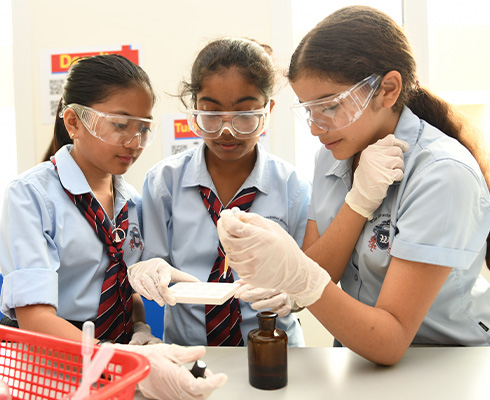
- Conducting practical investigations
- Asking questions and making predictions
- Gathering and analysing evidence
- Applying scientific knowledge to everyday situations
- Developing enquiry and investigative skills
Experiential Learning
Experiential learning is central to our educational philosophy. Students deepen their understanding by actively engaging in authentic experiences that connect classroom learning with the wider world.
Learning is enriched through:
- Practical scientific investigations
- Educational visits and fieldwork
- Outdoor learning experiences
- Enterprise and entrepreneurship projects
- Community engagement initiatives
- Collaborative research
- Leadership opportunities
- Cross-curricular themed learning
- Performing arts and public speaking
These experiences encourage students to apply knowledge, reflect on their learning, and develop confidence, resilience, and independence.
STEAM Learning
Our integrated STEAM (Science, Technology, Engineering, Arts and Mathematics) programme empowers students to become creative thinkers, innovators, and problem-solvers.
Students engage in exciting learning experiences including:
- Engineering and design challenges
- Scientific enquiry and experimentation
- Robotics and introductory coding
- Design thinking projects
- Mathematical modelling and problem-solving
- Creative expression through art and design
- Innovation projects addressing real-world challenges
By combining creativity with analytical thinking, STEAM learning prepares students for future careers while nurturing curiosity, collaboration, and innovation.
AI-Enhanced Learning
Technology is thoughtfully integrated throughout Key Stage 2 to enrich teaching and learning while developing responsible digital citizens.
Our AI-enhanced learning approach enables students to:
- Access personalised learning pathways
- Strengthen literacy and numeracy through adaptive learning platforms
- Conduct research using age-appropriate digital tools
- Develop computational thinking and coding skills
- Create digital presentations and multimedia projects
- Understand the ethical and responsible use of Artificial Intelligence
Students are encouraged to become confident, responsible users of technology, recognising AI as a powerful tool for learning, creativity, and innovation while maintaining critical thinking and human collaboration at the heart of the learning process.
Learning Beyond the Classroom
Learning extends beyond traditional classroom experiences, enabling students to develop confidence, leadership, and global perspectives.
Students participate in a wide range of enrichment opportunities, including:
- Sports and physical education
- Music, drama, and performing arts
- Educational visits and residential experiences
- Environmental and sustainability initiatives
- Student leadership programmes
- Public speaking and debating
- STEAM competitions and innovation challenges
- Cultural celebrations and international events
- Clubs, societies, and extracurricular activities
These opportunities encourage students to discover their passions, develop new talents, and become active contributors to their communities.
A Highly Personalised and Inclusive Curriculum
We believe that every child is unique and learns in different ways. Our inclusive curriculum is designed to ensure that every learner is supported, challenged, and inspired to achieve their full potential, regardless of their starting point, learning profile, strengths, or aspirations.
Through a highly personalised approach to teaching and learning, our educators carefully adapt learning experiences to meet the diverse needs of all students. Lessons are thoughtfully planned with appropriate levels of support, challenge, and enrichment, enabling every child to make meaningful progress while developing confidence, independence, and a love of learning.
Assessment for Learning
Assessment is continuous, purposeful, and designed to support every learner's progress.
Teachers use a wide range of assessment information to identify individual learning needs, monitor progress, and plan targeted interventions and extension opportunities. This evidence-based approach enables us to provide responsive teaching that supports every learner's academic and personal development.
Our personalised learning approach is informed by:
- Ongoing formative assessments that provide immediate feedback and guide daily classroom practice.
- Summative assessments that measure attainment and progress against curriculum expectations.
- GL Assessment data, including:
- New Group Reading Test (NGRT) to monitor reading accuracy, fluency, and comprehension.
- Progress Tests in English (PTE) to assess language, literacy, and communication skills.
- Progress Tests in Mathematics (PTM) to evaluate mathematical understanding and reasoning.
- Progress Tests in Science (PTS) to measure scientific knowledge and enquiry skills.
- Cognitive Abilities Test (CAT4) to identify students' learning potential, strengths, and preferred ways of thinking.
- Pupil Attitudes to Self and School (PASS) to understand students' wellbeing, engagement, confidence, and attitudes towards learning.
- International benchmarking assessments, including TIMSS (Trends in International Mathematics and Science Study) and PIRLS (Progress in International Reading Literacy Study), enabling us to benchmark student performance against international standards and continually refine our teaching practices.
By triangulating assessment data from multiple sources, teachers gain a comprehensive understanding of each learner's academic progress, cognitive strengths, wellbeing, and learning preferences. This enables them to personalise instruction, provide timely interventions, extend high-achieving learners, and ensure that all students are appropriately supported and challenged.
Through regular reflection, target setting, and personalised support, students develop confidence, resilience, and a growth mindset while striving for excellence.
Parents are actively involved in their child's educational journey through regular communication, progress reports, and parent-teacher consultations.
Our commitment to inclusive education ensures that every learner benefits from high-quality teaching, equitable opportunities, and a curriculum that values diversity, promotes belonging, and empowers students to flourish academically, socially, and emotionally.
Preparing for Key Stage 3
By the end of Key Stage 2, students have developed strong academic foundations, independent learning habits, and the confidence to embrace increasingly complex challenges.
They progress to Key Stage 3 as resilient, reflective, and inquisitive learners who are equipped with the knowledge, skills, and values needed to succeed in secondary education and beyond. With strong foundations in literacy, numeracy, scientific enquiry, digital literacy, creativity, and leadership, they are well prepared to thrive in an ever-changing global society.
Why Choose Our Key Stage 2?
- Follows the National Curriculum for England
- Broad, balanced, and academically rigorous curriculum
- Experienced and passionate British curriculum educators
- Strong emphasis on English, Mathematics, and Science
- Inquiry-led and experiential learning that connects learning to real-life contexts
- Integrated STEAM education to foster innovation, creativity, and problem-solving
- Age-appropriate AI-enhanced learning that develops digital confidence and responsible technology use
- Extensive opportunities for leadership, public speaking, and personal development
- Rich extracurricular and enrichment programmes
- Continuous assessment to support individual achievement and progress
- Excellent preparation for a successful transition into Key Stage 3
More To Explore
-
Curriculum Overview
The National Curriculum for England provides students with an education that is recognized and held in esteem around the world.
-
Extra-curricular Activities
At The Winchester School we encourage every child to explore their strengths and capabilities because we believe that ‘Every Child Matters’.
-
Professional Development
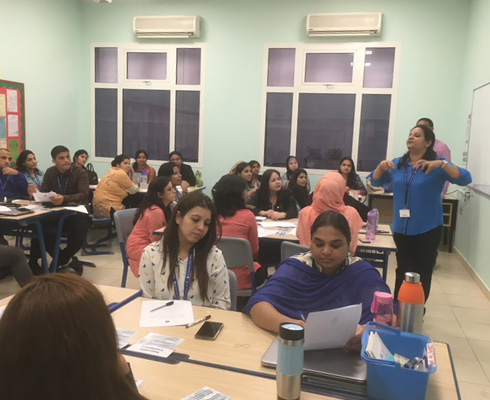
The aim of The Winchester School’s professional development is to provide specialized training in the latest pedagogy and classroom practices for educators.