Foundation Stages 1 and 2
Early Years Foundation Stage (EYFS)
The Early Years Foundation Stage (EYFS) at our school provides a nurturing, stimulating, and inspiring start to every child's educational journey. Comprising Foundation Stage 1 (FS1) and Foundation Stage 2 (FS2), our programme follows the Early Years Foundation Stage (EYFS) Framework for England, ensuring children develop the essential knowledge, skills, and confidence needed for lifelong learning.
We believe every child is unique, capable, and full of potential. Through a carefully planned blend of play, exploration, experiential learning, and meaningful interactions, our dedicated Early Years educators create a safe, inclusive, personalised and joyful environment where children feel valued, confident, and inspired to learn.
Our child-centred approach nurtures curiosity, creativity, resilience, and independence while fostering a lifelong love of learning.
A Positive Start to Learning
Starting school is an important milestone, and we are committed to making every child's transition from home to school smooth, enjoyable, and reassuring. Through warm relationships, engaging routines, and strong partnerships with families, children quickly develop a sense of belonging and confidence.
Our nurturing environment encourages children to:
- Develop confidence and self-esteem
- Build positive relationships with peers and adults
- Become independent learners
- Express themselves confidently
- Develop resilience and emotional wellbeing
- Explore, question, and discover through play and investigation
By creating a secure and stimulating learning environment, we lay the foundations for healthy social development, effective communication, and positive attitudes towards learning.
Our EYFS Curriculum
Our curriculum is based on the Early Years Foundation Stage Framework, which supports children's holistic development through seven interconnected areas of learning and development.
Prime Areas
- Personal, Social and Emotional Development
- Communication and Language
- Physical Development
Specific Areas
- Literacy
- Mathematics
- Understanding the World
- Expressive Arts and Design
Ministry of Education Subjects in Foundation Stage 2
- Arabic
- Islamic Education
- Social Studies
- Moral, Social and Cultural Education
- Moral Education
These areas are taught through purposeful play, guided exploration, enquiry-based learning, and carefully planned experiences that promote curiosity, creativity, and confidence.
Learning Through Play and Experiential Learning
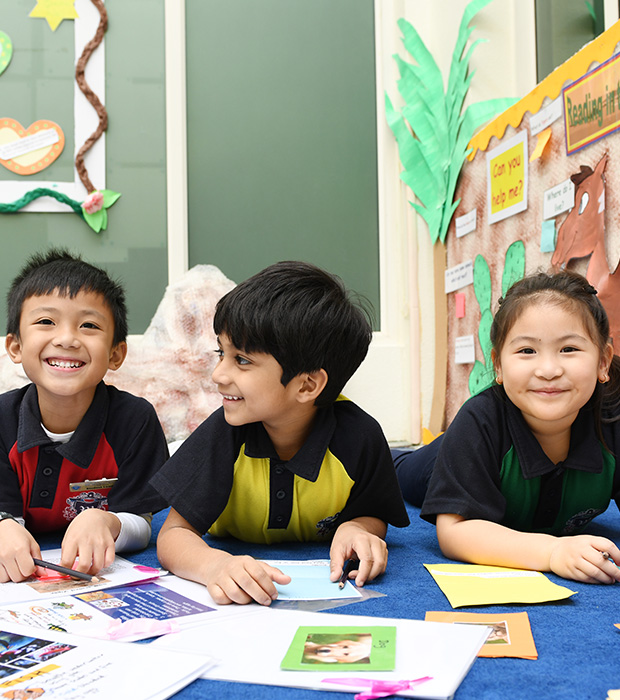
Play is at the heart of everything we do in EYFS. Children learn best when they are actively engaged, exploring their interests, making choices, solving problems, and discovering the world around them.
Our curriculum is enriched through experiential learning, where children learn by doing, reflecting, and applying their understanding in meaningful contexts. Carefully planned experiences encourage children to investigate, experiment, collaborate, and make connections between classroom learning and everyday life.
Through child-led exploration and skilled adult guidance, children develop:
- Curiosity and creativity
- Critical and independent thinking
- Communication and collaboration skills
- Confidence and resilience
- Problem-solving abilities
- A lifelong love of learning
Purposefully designed indoor and outdoor learning environments provide opportunities for children to explore, investigate, create, and learn through authentic experiences every day.
Building Strong Foundations in Literacy and Numeracy
Developing confident readers, writers, and mathematicians begins in the Early Years.
Our literacy programme includes:
- Systematic Synthetic Phonics
- Early reading and comprehension
- Storytelling and rich language experiences
- Speaking and listening development
- Mark-making and guided writing
- Vocabulary enrichment through meaningful conversations
Mathematics is introduced through practical, hands-on experiences that develop children's understanding of:
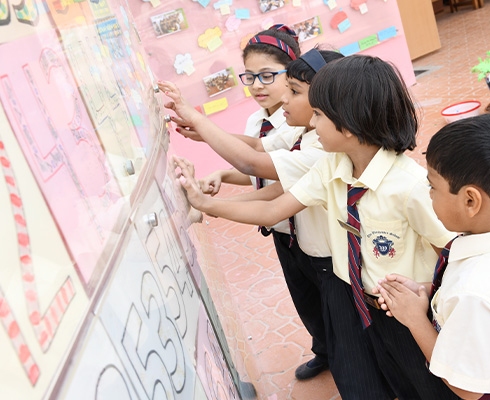
- Number recognition and number sense
- Counting and calculation
- Patterns and sequencing
- Shape, space, and measure
- Sorting and comparing
- Real-life mathematical problem-solving
These experiences ensure children develop secure foundations for future learning while fostering enjoyment and confidence.
STEAM Learning
We believe that curiosity drives innovation. Our Early Years programme introduces children to STEAM (Science, Technology, Engineering, Arts, and Mathematics) through engaging, age-appropriate experiences that inspire creativity, exploration, and innovation.
Children investigate the world around them by:
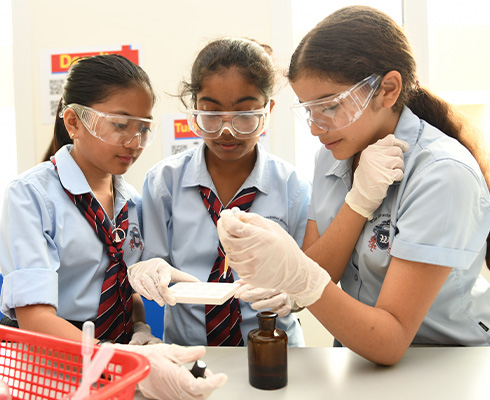
- Conducting simple scientific investigations
- Designing and constructing models
- Exploring engineering concepts through building challenges
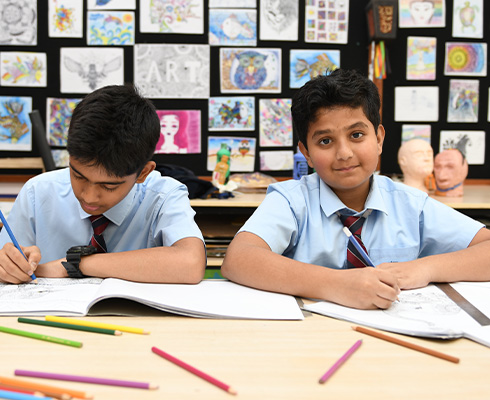
- Creating and expressing ideas through art, music, and design
- Solving practical mathematical problems
- Developing early computational thinking and coding concepts through play
Through experiential STEAM learning, children learn to ask questions, test ideas, collaborate with others, and reflect on their discoveries, nurturing the skills needed for future success.
AI-Enhanced Learning
As a forward-thinking school, we thoughtfully integrate Artificial Intelligence (AI)-enhanced learning into our Early Years programme in developmentally appropriate ways.
Technology is used to enrich children's learning while maintaining the central importance of play, human interaction, creativity, and exploration.
Children are introduced to technology through:
- Interactive storytelling and language development
- AI-supported educational platforms that personalise learning experiences
- Voice-assisted learning activities
- Creative digital expression
- Early computational thinking and logical reasoning
- Safe and responsible exploration of digital technologies
Our approach ensures that AI serves as a supportive educational tool, enhancing personalised learning while complementing the experiential, play-based nature of the EYFS curriculum.
Learning Beyond the Classroom
Learning extends beyond the classroom through meaningful experiences that encourage children to explore, discover, and engage with the wider world.
Children participate in a wide range of experiential learning opportunities, including:
- Outdoor and nature-based learning
- Sensory exploration
- Role play and imaginative experiences
- Gardening and environmental awareness activities
- Educational visits
- Community engagement projects
- Cultural celebrations
- Music, movement, and arts
- Sports and physical development
- STEAM exploration days and innovation challenges
These experiences deepen understanding, strengthen social skills, and encourage children to become confident, curious, and compassionate learners.
A Highly Personalised and Inclusive EYFS Curriculum
At the heart of our Early Years Foundation Stage is the belief that every child is unique, capable, and full of potential. We celebrate each child's individuality and provide a highly inclusive, nurturing, and personalised learning environment where every child feels safe, valued, and inspired to learn.
Our EYFS curriculum is carefully designed around the principles of the Early Years Foundation Stage (EYFS) Framework for England, recognising that children develop at different rates and learn in different ways. Through a balance of child-initiated exploration, purposeful play, and skilfully guided teaching, we provide learning experiences that respond to each child's interests, strengths, and developmental needs.
Our experienced Early Years educators use adaptive teaching to ensure that every child is appropriately supported, challenged, and encouraged to make excellent progress across all areas of learning. Carefully planned activities, enriched learning environments, and meaningful interactions enable children to develop confidence, curiosity, resilience, and independence while fostering a lifelong love of learning.
Assessment for Learning
Assessment in EYFS is continuous, observational, and child-centred. Teachers develop a deep understanding of each child's learning journey through:
- Ongoing observations during play and everyday learning experiences.
- High-quality interactions, conversations, and questioning.
- Formative assessment that informs planning and next steps in learning.
- Developmental milestones and progress measured against the EYFS Framework.
- Strong partnerships with parents, recognising them as children's first educators and valuing their contributions to each child's learning journey.
By bringing together observations, assessment, and close collaboration with families, our teachers create personalised learning experiences that nurture every child's academic, social, emotional, and physical development.
Our commitment to inclusion ensures that every child benefits from equitable opportunities, high-quality teaching, and a stimulating environment where they are encouraged to explore, discover, create, and flourish. We lay strong foundations that prepare children not only for a successful transition into Key Stage 1 but also for a lifetime of confident, joyful learning.
Our Learning Environment
Our purpose-built Early Years classrooms are carefully designed to encourage exploration, creativity, independence, and collaboration.
Children benefit from:
- Bright and engaging indoor learning spaces
- Safe outdoor learning environments
- Interactive discovery areas
- Sensory and creative learning zones
- Reading and storytelling corners
- Bike area
- Maths and Movement Area
- Garden Area
- Play zone
- Soft canopy area
- Construction and investigation areas
- Technology-enabled learning experiences
- Flexible spaces that support collaborative and independent learning
Every environment is thoughtfully planned to inspire curiosity, foster independence, and promote joyful learning.
Preparing for Key Stage 1
By the end of Foundation Stage 2, children are confident, resilient, and enthusiastic learners who are well prepared for the transition into Key Stage 1.
They leave the Early Years with strong foundations in literacy, numeracy, communication, social and emotional development, and independent learning. Equipped with curiosity, creativity, critical thinking, and a growth mindset, they are ready to embrace new challenges and continue their educational journey with confidence.
More To Explore
-
Curriculum Overview
The National Curriculum for England provides students with an education that is recognized and held in esteem around the world.
-
Extra-curricular Activities
At The Winchester School we encourage every child to explore their strengths and capabilities because we believe that ‘Every Child Matters’.
-
Professional Development
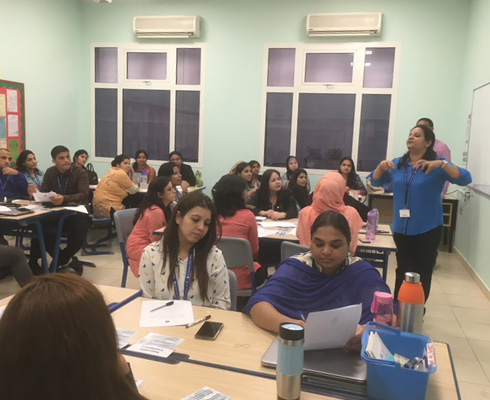
The aim of The Winchester School’s professional development is to provide specialized training in the latest pedagogy and classroom practices for educators.