
Mathematics Department - Primary
Developing Confident Mathematicians and Future-Ready Problem Solvers
At The Winchester School, we believe that mathematics is far more than numbers—it is a powerful tool for understanding the world, solving problems, and making informed decisions. Our ambitious and engaging mathematics curriculum, based on the National Curriculum for England, develops confident, curious, and resilient learners who are equipped with the knowledge, skills, and mathematical thinking needed to succeed in school and beyond.
Through a fully inclusive, highly personalised, and mastery-based approach, we inspire every child to develop mathematical fluency, reason logically, think critically, and apply their learning confidently in meaningful real-world contexts. By integrating experiential learning, STEAM, Artificial Intelligence (AI)-enhanced learning, and innovative technologies, we empower students to become future-ready learners who embrace challenge, creativity, and innovation.
Head of Department
Ms. Steffe Henriques
Head of Primary Mathematics and Deputy Head of Primary
Email: [email protected]
Our Department Philosophy
Our vision is to nurture confident and capable mathematicians who enjoy learning, embrace challenge, and recognise the relevance of mathematics in everyday life.
We aspire to develop learners who:
- Demonstrate fluency and confidence in mathematical concepts and procedures.
- Think logically, reason mathematically, and communicate their thinking with clarity.
- Solve increasingly complex problems using creativity, resilience, and perseverance.
- Apply mathematical knowledge across the curriculum and in authentic real-life situations.
- Work collaboratively while developing independence and a growth mindset.
- Use technology responsibly to enhance mathematical understanding.
- Become innovative, analytical, and future-ready learners.
Mathematics Across the Primary School
Mathematics is taught through a carefully sequenced and progressive curriculum that develops deep conceptual understanding, mathematical fluency, reasoning, and problem-solving skills. Learning builds systematically from the Early Years Foundation Stage through to Key Stage 2, ensuring continuity, progression, and challenge at every stage.
Early Years Foundation Stage (FS1 & FS2)
In the Early Years Foundation Stage, mathematics is delivered through the EYFS Statutory Framework for England, where Mathematics is one of the seven areas of learning and development.
Children develop their mathematical understanding through purposeful play, exploration, practical experiences, and meaningful interactions in both indoor and outdoor learning environments. Teaching is designed to foster curiosity, confidence, and a positive attitude towards mathematics while encouraging children to investigate, reason, and make connections in everyday contexts.
Learning focuses on the two key areas of mathematical development:
- Number
- Numerical Patterns
Children develop early mathematical concepts through counting, subitising, recognising patterns, comparing quantities, exploring shape, space, and measure, and applying mathematical thinking in real-life situations.
Key Stage 1 (Years 1–2)
In Key Stage 1, students follow the National Curriculum for England, building on the strong mathematical foundations established in the Early Years. Teaching focuses on developing secure understanding through practical experiences, mathematical talk, and increasingly abstract thinking.
The curriculum develops proficiency across the three key aims of mathematics:
- Fluency in recalling facts and performing calculations efficiently.
- Mathematical Reasoning by explaining, justifying, and communicating mathematical thinking.
- Problem-Solving by applying mathematical knowledge in a variety of familiar and unfamiliar contexts.
Students study the following areas of mathematics:
- Number
- Measurement
- Geometry (Properties of Shape)
- Geometry (Position and Direction)
- Statistics
Key Stage 2 (Years 3–6)
In Key Stage 2, learners deepen their conceptual understanding and develop increasing confidence in applying mathematics across a range of contexts. Teaching encourages students to think critically, reason logically, solve increasingly sophisticated problems, and make meaningful connections between different areas of mathematics.
The curriculum continues to build proficiency in:
- Fluency
- Mathematical Reasoning
- Problem-Solving
while extending learning across:
- Number
- Measurement
- Geometry (Properties of Shape)
- Geometry (Position and Direction)
- Statistics
Through a mastery approach, experiential learning, and real-world applications, students develop the confidence, resilience, and mathematical understanding needed for success in secondary education and beyond.
A Highly Personalised and Inclusive Mathematics Curriculum
We believe that every child can succeed in Mathematics. Our curriculum is designed to ensure that all learners, regardless of their starting point, learning profile, or ability, are appropriately supported, challenged, and inspired to achieve their full potential.
Through adaptive teaching, responsive planning, and carefully designed learning experiences, teachers personalise learning to meet the diverse needs of every learner. Appropriate scaffolding, targeted intervention, enrichment, and challenge enable all students to make excellent progress while developing confidence, independence, and a positive attitude towards mathematics.
Our personalised approach is underpinned by a robust assessment framework. Teachers use a comprehensive range of assessment evidence to identify individual strengths, monitor progress, and inform responsive teaching. This includes:
- Ongoing formative assessment through observation, questioning, quizzes, feedback, and classroom discussions.
- Summative assessments aligned with the National Curriculum for England.
- GL Assessments, including the Progress Test in Mathematics (PTM) and the Cognitive Abilities Test (CAT4).
- International benchmark assessments, including the Trends in International Mathematics and Science Study (TIMSS), where applicable.
By triangulating assessment evidence from multiple sources, teachers gain a holistic understanding of each learner's progress, enabling them to personalise learning, provide timely intervention, extend higher-attaining learners, and ensure every child flourishes.
Teaching for Mastery
Our mathematics curriculum is underpinned by the principles of Teaching for Mastery, ensuring that all learners develop a deep, secure, and connected understanding of mathematical concepts.
Rather than moving quickly through content, students develop conceptual understanding before progressing to more complex ideas. Lessons encourage children to make connections, think deeply, explain their reasoning, and apply mathematics confidently in different contexts.
In line with the aims of the National Curriculum for England, our teaching develops:
- Fluency in mathematical knowledge and procedures.
- Mathematical reasoning, enabling students to explain, justify, and prove their thinking.
- Problem-solving, where learners apply mathematics confidently to unfamiliar and increasingly sophisticated situations.
This mastery approach develops confident learners who understand mathematics rather than simply memorising procedures.
How We Teach Mathematics
Our teaching follows the internationally recognised Concrete–Pictorial–Abstract (CPA) approach, enabling children to build deep conceptual understanding through carefully sequenced learning experiences.
Students learn by progressing through three stages:
- Concrete: Exploring concepts using practical resources and mathematical manipulatives.
- Pictorial: Representing ideas through diagrams, visual models, and mathematical representations.
- Abstract: Applying understanding using symbols, notation, and formal mathematical methods.
Rich mathematical discussions, purposeful questioning, collaborative learning, and carefully designed problem-solving tasks encourage children to articulate their thinking, justify their strategies, learn from mistakes, and develop resilience and confidence.
Experiential Learning and STEAM
Mathematics becomes meaningful when learners experience it in authentic contexts.
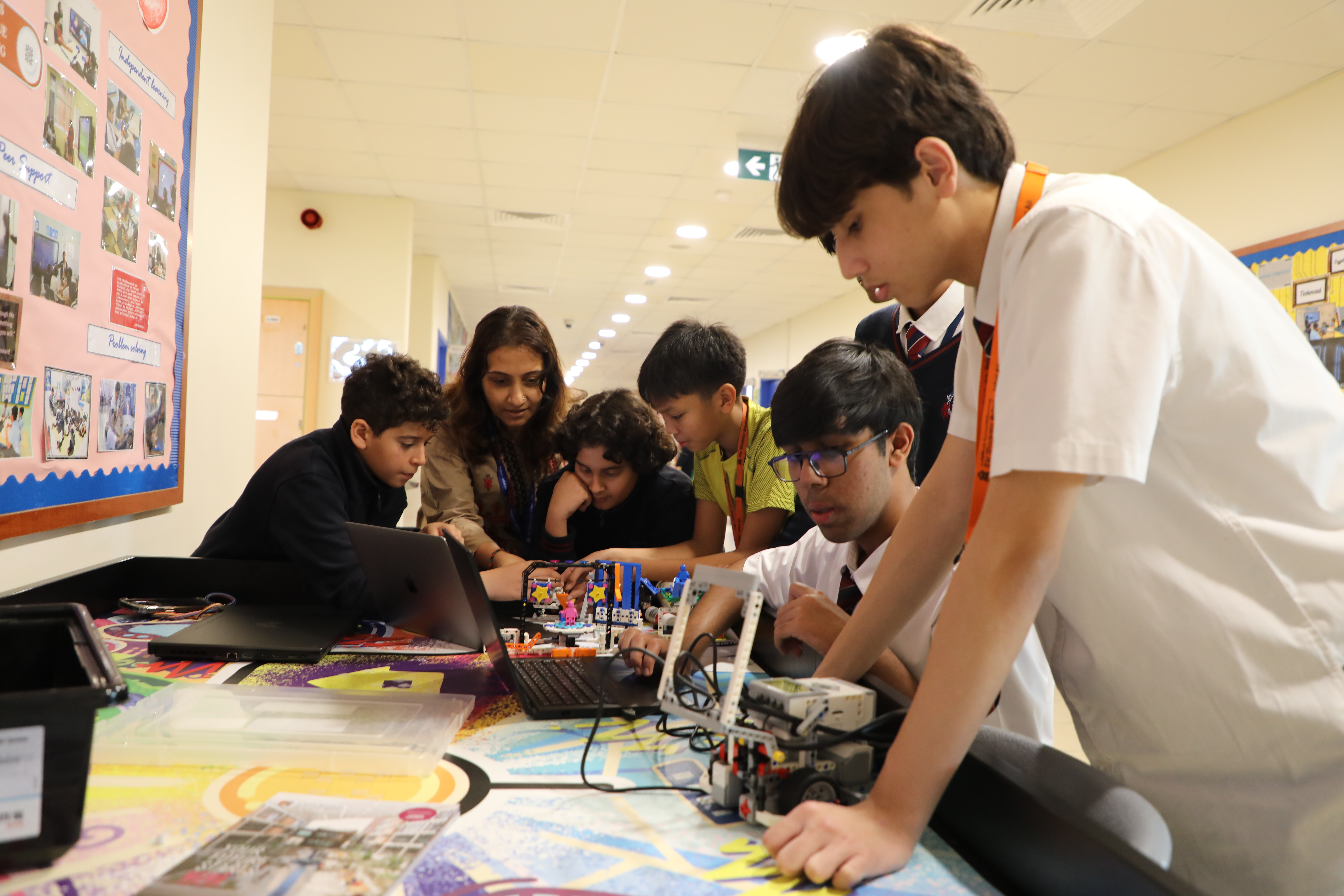
Through experiential learning and STEAM education, students investigate, design, create, and solve real-world problems while making meaningful connections across Science, Technology, Engineering, the Arts, and Mathematics.
Learning is enriched through:
- Practical mathematical investigations
- Enterprise and financial literacy projects
- Outdoor learning
- Data handling and statistical enquiries
- Engineering and design challenges
- Cross-curricular STEAM projects
- Collaborative problem-solving
- Real-world applications of measurement, geometry, and number
These experiences develop creativity, innovation, critical thinking, collaboration, and resilience while demonstrating the relevance of mathematics beyond the classroom.
AI and Digital Innovation in Mathematics
Technology is thoughtfully integrated throughout our mathematics curriculum to enrich learning, personalise instruction, and deepen conceptual understanding.
Students engage with Artificial Intelligence (AI)-enhanced learning, adaptive digital platforms, interactive mathematical tools, and virtual manipulatives that provide personalised feedback and learning pathways tailored to individual needs.
Our learners use technology to:
- Explore mathematical concepts through interactive simulations.
- Develop computational thinking and logical reasoning.
- Analyse and interpret real-world data.
- Solve problems collaboratively using digital technologies.
- Receive immediate feedback to strengthen understanding and accelerate progress.
Alongside developing digital confidence, students learn to use emerging technologies responsibly, ethically, and purposefully as they prepare for an increasingly technology-driven future.
Assessment for Learning
Assessment is an integral part of effective teaching and learning.
Teachers use ongoing formative assessment alongside carefully planned summative assessments to monitor progress, celebrate achievement, and identify personalised next steps.
Assessment includes:
- Ongoing formative assessments
- Classroom observations and questioning
- Feedback and responsive teaching
- Self and peer assessment
- End-of-unit assessments
- Summative assessments aligned with the expectations of the National Curriculum for England.
- GL Progress Test in Mathematics (PTM)
- Cognitive Abilities Test (CAT4)
- TIMSS benchmarking, where applicable
Assessment outcomes are used to inform adaptive teaching, targeted intervention, enrichment opportunities, and personalised learning pathways that ensure every learner achieves sustained success.
Learning Beyond the Classroom (Enrichment Opportunities)
We believe that mathematical learning extends beyond daily lessons and is enriched through a wide range of experiences that inspire curiosity and enjoyment.
Students participate in:
- Mathematics Week
- Maths Olympiads
- KenKen International Championship (KIC)
- Mental Maths Challenges
- Inter-school mathematics competitions
- Problem-solving challenges
- Enterprise and financial literacy projects
- STEAM innovation challenges
- Educational visits
- Cross-curricular investigations
- Mathematics clubs and enrichment activities
- Supermarket Day
- Maths Magic Day
- Math Workshops for Parents
These opportunities encourage collaboration, leadership, resilience, and a lifelong appreciation of mathematics.
Useful Maths websites
- www.mathssphere.com
- www.mad4maths.com
- www.ixl.com
- www.primaryresources.co.uk
- www.bbc.co.uk/schools/ks1bitesize/numeracy
- www.crickweb.co.uk
- www.mathsisfun.com
- www.woodlands-junior.kent.sch.uk/maths/
- www.teachingmeasures.co.uk/
- www.mathsisfun.com
- www.aplusmath.com
- www.nrich.maths.org.uk
- www.topmarks.co.uk
- www.bbc.co.uk/schools/numbertime
- www.mathsphere.co.uk
- www.schoolzone.co.uk
- www.primaryresources.co.uk
- www.bgfl.org
Preparing Learners for the Future
Our mathematics curriculum prepares students not only for success in secondary education but also for the opportunities and challenges of an increasingly complex and interconnected world.
By combining the academic rigour of the National Curriculum for England with inclusive practice, highly personalised learning, Teaching for Mastery, experiential learning, STEAM, AI-enhanced learning, and innovative digital technologies, we develop confident, analytical, and adaptable learners who are equipped to solve problems, think critically, and contribute meaningfully to society.
At The Winchester School, we inspire every child to see mathematics as a powerful tool for understanding the world, unlocking opportunities, and shaping the future.